
Territorial carbon assessment, municipal administration carbon assessment, and local climate action plan
With the entry into force of the Climate Regulation (RClim) and the increasing requirements in climate policy, municipalities are expected to measure their emissions, plan their actions, and track their progress.
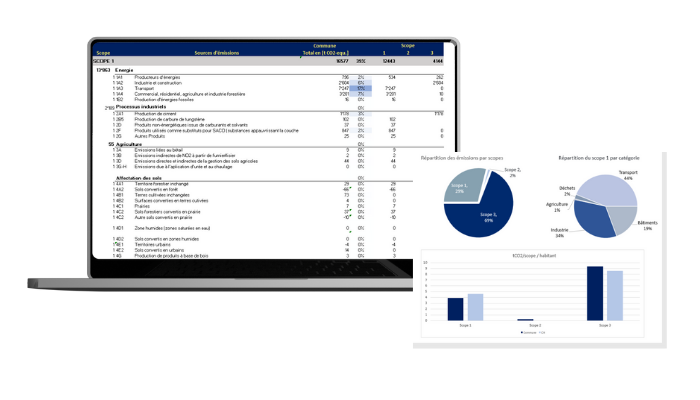
Mandated by the Canton of Fribourg, via the Environmental Service (SEn), we have developed a tool for territorial carbon assessments as well as solutions dedicated to municipal administrations. We support municipalities in developing their Climate Plan and implementing concrete measures. In this context, subsidies are available to accelerate the transition to action. To be eligible, municipalities must notably carry out a territorial assessment and a municipal administration carbon footprint.
Our support to structure your municipality’s climate strategy
- A Municipal Climate Plan
- A Territorial Emissions Inventory
- An Administrative Emissions Inventory
We support local authorities in the development of their Climate Plan and in the implementation of concrete actions. In this context, public funding schemes are available to accelerate the transition from planning to action.
To be eligible, municipalities are typically required to carry out both a territorial greenhouse gas emissions inventory and an emissions inventory of the municipal administration.
How we support your municipality:
- Definition of scopes and boundaries (territory / administration)
- Preparation of emissions inventories (territorial / administration)
- Interpretation of results and identification of priority actions
- Development of the Climate Plan
- Support with funding applications
- Ongoing support throughout implementation
1. Municipal Climate Plan
A climate plan enables your municipality to structure its strategy around two pillars: mitigation (reducing emissions to limit climate change) and adaptation (anticipating the now unavoidable impacts of climate change).
A Climate Plan is based on two complementary assessments (explained below):
• the territorial assessment, measuring the emissions generated across the entire municipal territory
• the administration assessment, quantifying emissions linked to the municipality’s own activities
Together, these analyses provide a solid foundation for building a coherent climate strategy. We help you understand what a Climate Plan must contain and assist you in developing it effectively and realistically.
2. Territorial Carbon Assessment
The territorial assessment measures CO₂ emissions generated across the entire municipal territory (building heating, mobility, agriculture, waste, etc.). Because this analysis can be complex and requires consistent data, we have developed a unique tool that calculates the territorial CO₂ balance for any municipality. Its advantages:
• based on the latest federal and cantonal statistics
• available in two clicks
• regularly updated
This approach ensures an agile, reliable and always up-to-date tool that adapts to data developments and cantonal requirements while staying aligned with municipalities’ practical needs.
We provide our expertise by identifying the main emission sources and the most relevant levers of action for your context.
3. Municipal Administration Carbon Footprint
The municipal administration assessment quantifies emissions linked to municipal operations (public buildings, professional mobility, etc.). It identifies the concrete actions the municipality can take.
To support this step, municipalities benefit from a standardized form specifically designed for their carbon accounting.
This form, integrated into the CO₂ Platform (developed by Climate Services), enables straightforward and structured data collection. Through CO₂pilot, we have also created a practical guide that explains step by step:
• which data to collect
• how to enter it into the platform
• how to correctly interpret the results
• how to identify first reduction measures
This combination of platform and guide ensures a consistent approach aligned with recognized standards. We then provide a clear interpretation of your results, highlighting the main emission sources, relevant action levers, and priority measures to integrate into your Climate Plan.